Showing posts with label grow. Show all posts

April 20, 2011

Guide to Finding the Fresh, Local, and Green

DSC_0040

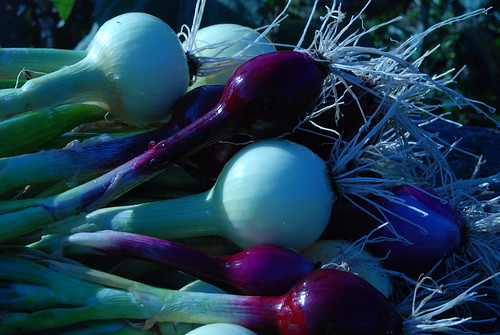
Spring is slowly awakening here in Minnesota. I started a new job on a farm on Monday, which is why I haven't posted until today. It has been nice to get outside and feel more connected with the earth. We're supposed to get snow tonight, but planting seeds means that spring really is going to come one of these days. I don't know if you are planting seeds of your own, visiting farmer's markets or still waiting for spring, but I wanted to point out some of the options that are available if you are eager to eat more fresh and locally grown. I know I've written on each one with some length, but I wanted to describe them as well as I could. I've added links and resources, too. If you have other ideas for finding farms and markets please share!

CSA - Community Supported Agriculture is a system that many farms use. Farms offer a share (which might feed 1 person or could be enough for a whole family) of produce for the farm season and members pay the full price up front. It is kind of like investing in a farm -- you pay a certain amount at the beginning of the season which gives the farmer capital to order seeds and get started. In exchange, the farmer provides you with a regular supply of vegetables. While most of the focus is one what you get from the farm, the beauty of the CSA system is that you are giving to the farm, too.

Many CSAs simple provide a weekly box of produce, others give members credit so they can pick out what they want. Some CSAs include eggs, milk or meat and still others focus on fiber or fruit. Some farms also do winter shares so you can keep getting locally grown food during the colder months. Although it may seem like a big investment at first, your investment will stretch much farther when you are dealing directly with a farm instead of shopping for produce at a market. Keep in mind that the although most farms provide a wide variety, they are limited as the what they can harvest at different times of year. It is a great way to get in touch with the seasons of a farm and to learn to use a variety of vegetables.

Farmers Markets - Some CSAs allow members to get their produce at the market, but generally a farmer's market is just for retail. Many farmers bring their goods to sell (usually produce, but also baked goods, flowers, meat, dairy products and artisanal specialty foods) and you can pick out whatever you like. The prices are probably higher than at the grocery store, but the quality is better, too. Farmer's markets are also a great way to meet the people who grow the food you eat. When you eat local food like this, you can get to know the growers and ask them questions about how they grow it, what they grow and how to use the products that they sell. Local Harvest is a great website to find markets near you.

Farm Stands - I've lived in some rural areas where farms or sometimes smaller growers have a stand or spot by their house where they place the produce for sale. Sometimes the stand is attended other times it is based on the honor system. You take what you would like and leave money in a can. I love stopping at these little spots along the road, you can find some great very fresh food and it is nice to support the people in your community who care for the land and protect undeveloped open spaces.

Grocery Stores - Since interest in and demand for growing local food many grocery stores and co-ops stock their produce section with locally grown. It's not the same as buying directly from the farmer, but it is always good to take advantage of the locally grown food that is available.

Community Gardens - If you want to grow your own food, there are plenty of options, too. Community Gardens can be found in urban and suburban areas. Different places do it differently. Often it is an area of land sectioned off into plots that you pay a small fee to use for the season. Sometimes the garden is completely communal and members work together to grow all of the food. Community Gardens usually provide guidance and information for new gardeners and there are usually seasoned growers around to make suggestions or give advice. Sometimes the gardens have rules about what you can or cannot grow and how you plot should be maintained and they also have tools and lots of other resources to help you get growing. The American Community Gardening Association can help you find a community garden near where you live. 

Your back yard - Before you start digging up the lawn, make sure to get the soil tested. This will give you information about what you might need to add to the soil and will also warn you if there is lead. Many urban and suburban areas have lead in the soil but that is not an insurmountable obstacle. Your yards is a fabulous place to grow food that is as local as possible. Kitchen Gardeners International is a good place to look for ideas, resources and other back (or front) yard gardeners.

Your front steps, porch, deck or fire escape - I don't have land to plant in myself, but I am planning to grow a few vegetables and some herbs in pots on my back porch. I hope to get this started very soon (once it stops snowing for good!). I'll be sharing my porch garden exploits here, but this book also looks like a great way to get started.

October 29, 2009

Starting with the seeds and soil

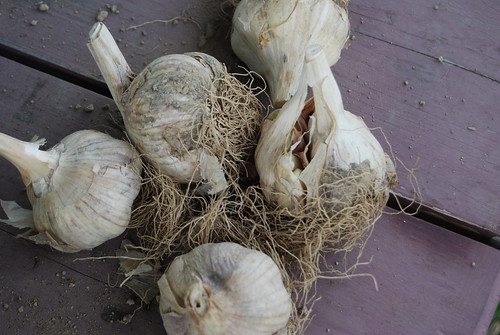
seed garlic

Gray skies, frosty ground, and nearly freezing air.  Its the tail end of the growing season here.  This is the time when longing for a comfortable seat by the woodstove is balanced with cheeks flushed as I warm up with physical work in the cold air. Of course I am not farming full time this year, but the other day I went to the community garden to accomplish the last task of the season:  planting garlic.

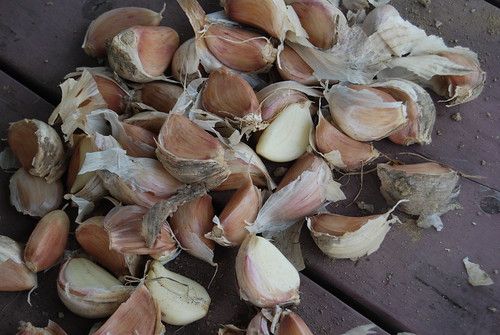
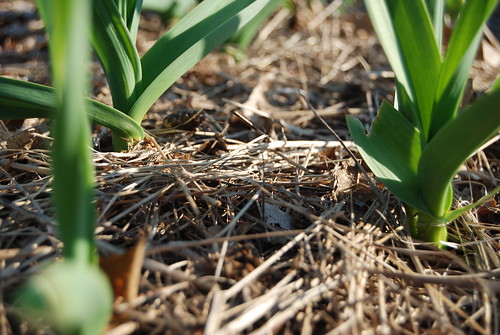
Like the tulip bulbs I planted all over yard in autumn as a child, garlic goes into the ground in late October.  Its nice to have one crop that is already taken care of when its time to start planting in the spring.  After a long winter's slumber in the frozen ground the garlic will sprout strong and green.  The smell of the cloves as I separate each one reminds me of the flavorful bulb that each one will become.

ready to plant for next season

On this quiet overcast morning, a few birds burst in and out of the trees.  The dampness from the frost on the fading green grass and the fiery colors of the leaves provides a bright contrast against the sky.  The air is cold, and the ground likely too, but to protect myself from this I wear a pair of dusty work gloves.  I hate to shield my hands from really getting into the earth but they would be way to cold to work if I didn't.  As I move the spading fork into the ground to loosen the soil in this bed my body becomes warm and the cool air on my cheeks and the smell of the cold damp remind me how good it is to be alive.  To be alive and outside in this small patch of earth, which, I hope has fed many this season.  We were able to harvest about 2500 pounds of produce this year, and hopefully this made a small difference to those who need.  Now is the beginning of the time for the garden's rest.

Garlic planting is often a welcome marker of the end of the garden year.  All the harvesting is done, the beds are cleared and each clove of garlic gets tucked deep into the soil to rest for months before the cycle begins again.  Even though I am putting the garden to bed, I find the smells of the soil, the garlic, the leaves fluttering down from trees to the earth, are all reawakening my desire to do more of this.  I have been in the kitchen a lot lately.  I love dreaming up new creations and the excitement of making something delicious, satisfying and sustaining.  Back in the garden, though, I am reminded of how much further I want to go into the process:  food starting with the seeds and soil long before it reaches the kitchen or a plate.

I admire, and slightly envy, those who have found their dreams and are pursuing them relentlessly.  I have my dream of growing lots of vegetables and of a small farm and I know that this dream will eventually sprout strongly out of the ground.  For now, though, I am part of an equally beautiful and fulfilling dream where Ray and I have to work together to figure out how our future will happen.  We're working on plans that will work for both of us and, while I hope to do a lot more vegetable growing in the next season or so, the larger dream will probably have to slumber in the ground until the time is right to grow further.  The soil is rich and soft and full of life.

End of the garden year

September 4, 2009

Garden Morning

DSC_0036

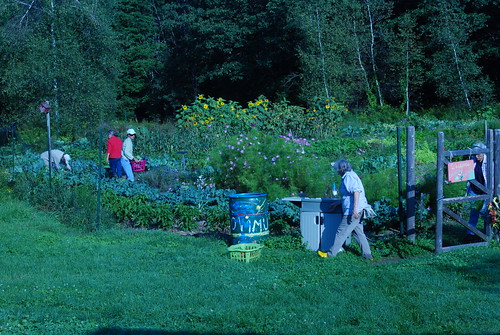
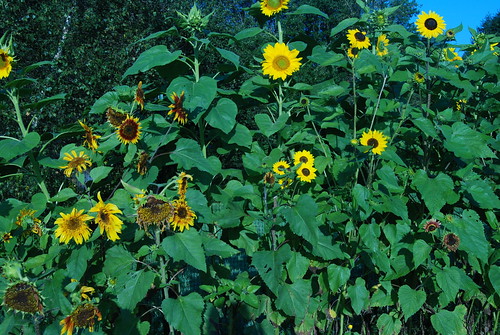
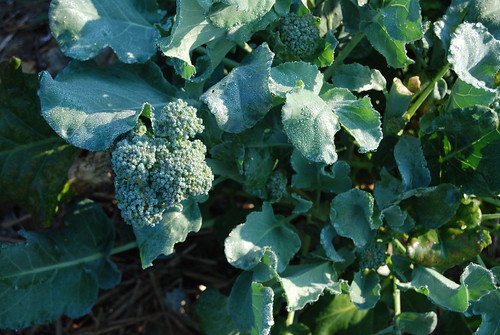
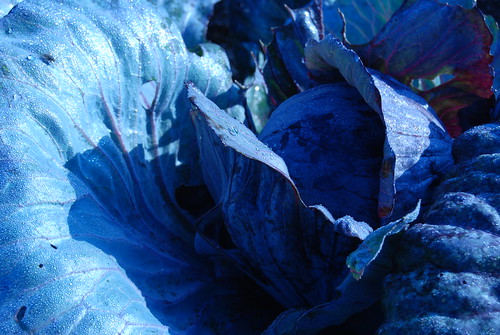
It was a cool morning in the community garden, the light of early fall, dew heavy. Except for the tomatoes which did not survive late blight, everything is growing well. There are so many obstacles and challenges -- excessive rain, insects and other hungry critters, weeds, diseases, then not enough rain. But its far from a fight. The plants do what they do best: grow and keep growing. We planted tiny brussels sprouts seedlings and eggplants that seemed like they would never get any bigger. We certainly lost a few, but now these tiny sprouts are tall and flourishing: the miracle of the seed continues.

DSC_0053

The often hard work of growing and maintaining a garden is tempered by working as a group. Two times a week, a group gathers here to harvest everything that is ripe and ready. Amid conversation and new connections, we gather food which is shared with neighbors and community members who wouldn't have access to such fresh and delicious plants which travel a fast, short distance to food pantry or front porch, ready to be eaten.

DSC_0040

Its hard not to admire the beauty and bounty and to really appreciate the community that comes together to make it happen.

DSC_0046

DSC_0038

DSC_0044

DSC_0054

The light! The color! The soft soil under my feet, the potential for fabulous tastes and full bellies, these things bring me to the garden.

August 16, 2009

Worms!


I've been wanting to make a worm bin for a year or so. Being an avid eater of vegetables and whole foods, and thus a producer of vegetable scraps I needed a place to recycle them. Although some of my upstairs neighbors simply drop their scraps out the window into the alley behind our building, I have been hoping to do something more productive with some of my food waste. Its taken me a while to finally make a worm bin, but thanks to my friends Jen and Dani who gave me the gift of worms for a wedding shower present back in the spring, I finally got to have a bin of my own.

I'm a little behind the times. I mean, the New York Times had an article on worm bins in the city a while ago, but despite that it took me some time to get around to building a bin. I was a little intimidated by the bin itself -- what if I messed it up or didn't provide an adequate home for the busy little wigglers? Well, it turns out to be really easy and worth while. Our bin is small, so the worms can't handle all of the veggie scraps we have, but its a good start.

In case you aren't familiar with worm bins -- it is a simple way of turning food waste into rich dark worm castings which are great for adding to soil for healthy plants. With some help from Worm Mainea, I made a simple home for the worms where they can munch on the mold and fungi that break down the food. To make a worm bin, you just need a few simple materials. You can use a wooden box, but it was easier for me to obtain a plastic storage tub which would fit under my kitchen sink.

Drilling air holes

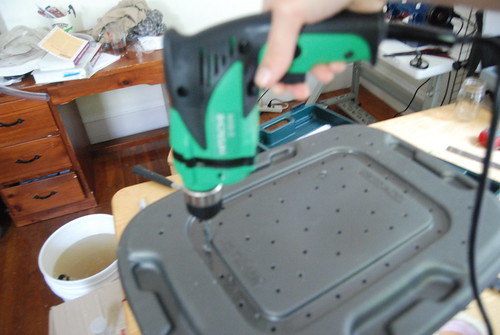
I drilled holes in the top to let in air. You can cover the holes with a screen to keep fruit flies out. I also added a drainage hole at the bottom in case there is too much liquid in the bin which is just closed with a cork and some masking tape. If the bin needs draining, this will do the trick.

Worms

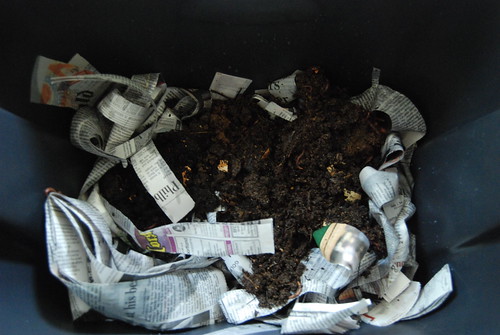
To make bedding for the worms, rip up newspaper into long thin strips and dampen it with water so that it is moist but not wet. The worms are red wigglers, not earth worms, so you will need to order them from a supplier or get them from someone who has an excess of worms in their bin (over time the number of worms in the bin will increase). I put the worms on top of the newspaper and then put more shredded damp paper on top of them.

DSC_0702

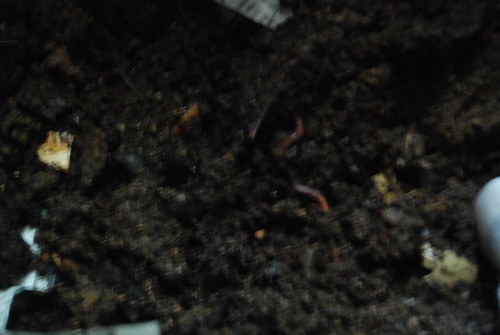
Worms like: coffee grounds and filters, vegetable and fruit scraps, paper and cardboard, breads and grains, tea leaves and bags (no metal staples, though), and egg shells. Worms do not like: meat, fish, bones, dairy, grease, vegetable oil, pet waste, dirt from outside, salt. The worms can only keep up with half the weight of the worms per week. I started with a pound of worms, so they can take about a half pound of "worm food." I usually check on them every week or so to see if the other food has broken down yet. Each time I add food, I put it in a different corner, under the top layer of bedding. More newspaper bedding should be added as the bedding breaks down. Following these guidelines will keep the environment in your bin well balanced and smelling good. So far, my little pets seem healthy and happy (well, I don't know about that) and they are taking care of some of my food scraps each week. Eventually there will be enough worm castings to remove some of the castings and use them to fertilize plants. It will take some time, but its nice to have this recycling system under my kitchen sink.

May 15, 2009

I am taking a permaculture class this month and we have been looking at patterns in nature. Regular, irregular, spiraling, repeating and scattered, once I start looking I see them everywhere.

DSC_0577

DSC_0584

DSC_0586

DSC_0578

DSC_0588

May 6, 2009

Signs of Life

DSC_0585

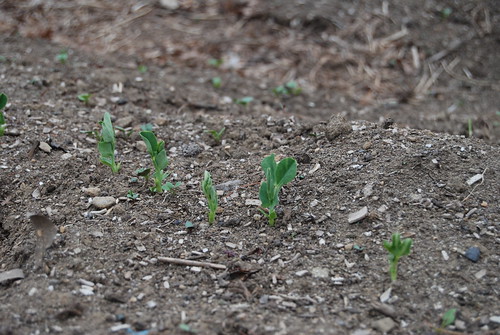
A few weeks ago I planted the first seeds of the year. The miracle of something so small, hard and shriveled awakening from the dark, cool soil has begun. For now the little sprouts are so precious, worth a picture, even. They will grow and flower to produce sweet tender pea pods and succulent peas for eating out of the shell. Eventually they will be overgrown and unruly and stop producing and it will be equally satisfying to pull out the stalks and clear away the debris. I love that, even though spring comes every year and sprouts and shoots always grow, it always seems new and somewhat unbelievable to be surrounded by so much green when things have been frozen for so long.

DSC_0579

It seems like everyone at the community garden has been as eager as a seedling to be in the sun and soil. We had a work day which exemplified the power of teamwork. With everyone putting in an hour or two we accomplished far more than I had hoped and I could not thank everyone enough for the part that they did to help get the garden ready. There is lots more of this to come.

Garlic

Not only is everything blossoming, leafing, singing, and growing voraciously, but I am feeling the busy-ness of spring quite fully. Everything in nature is going full force, the days are rapidly getting longer and I am juggling a few jobs, a class and still trying to find time to take in the season. There's really nothing I can do but rush in fully and try to catch the energy of spring.

April 7, 2009

Dreaming of Bountiful Gardens

It is a chilly April day here in Maine. After a couple days of April showers, any hints of sun are welcome and in contrast to the the gray of the sky, the grass is becoming bright green. Although its still early for planting, its not too soon to order seeds and make plans for a garden. Since a few people have asked me for some suggestions for planting a garden, I thought I would share some ideas for getting started. I'm sorry I don't have a picture of the beginnings of spring to go with this, but I hope that you can look out your window to see something of new growth and blossoming life.

It seems like many many people are interested in gardens this year which is fabulous. Though the farmer's market can provide an abundance of delicious local food, it is hard to beat walking out your back door and biting into a tomato that is still warm from the sun or brushing the soil off a carrot and crunching into its sweet, earthy taste. Its one thing to know where your food comes from, its another to know that you grew it yourself.

Starting out can be a little daunting. There are so many different ideas, theories, and techniques ranging from double digging to no-till sheet mulching. But don't be overwhelmed -- you don't have to do it perfectly. Plants want to grow, seeds are meant to sprout. To me, it is one of the most mysterious and beautiful things on earth -- that you can take a tiny, hard, odd-shaped seed and give it soil, water, warmth, light and with some nurturing it will become fragrant basil, a juicy cucumber, hardy kale or a flower that reaches for the sun. This doesn't mean that every single thing you plant will grow and flourish. Such is life. But when you start out it doesn't have to be complicated. You will learn as you go and add more and more over time.

This year I will be growing vegetables at a community garden which will be donated to local food pantries. Since I know this will be a busy summer I am not planning to have my own garden, except for an abundance of containers on our porch which I hope to fill with lots of flowers and vegetables. I look forward to sharing some of that here. Whether you are ready to start planting or still watching the snow melt, here are some suggestions and resources for those of you who are new to gardening to help you begin your endeavors.

Test the soil
This one is really important. Near old houses or in urban areas it is crucial to test the soil to make sure that it does not contain lead which can be absorbed by the plants that you will eat. Soil tests can also reveal what your soil might be lacking and what amendments you might need to add to help your plants grow better. You can get test kits from your local university or cooperative extension. If you do have lead in the soil, you can garden in containers, build raised beds or use a barrier and bring in new soil so the plants roots can't reach the contaminated soil, or try lead remediation techniques (which will take a few years).

Start Small Its hard not to dream of large bountiful gardens, but growing vegetables does take work and it should be fun. Start with what seems manageable to you, if you try to do too much it will be hard to maintain all of your plants and they will not do well. Grow a window box full of lettuce, a few pots of herbs, or a small garden bed with whatever vegetables you most want to grow this year -- next season you can do more. You do not have to start all of your plants from seed, either. Its fun to grow your own seedlings, but if you don't have time or space, seedlings grown in greenhouses are usually bigger and hardier to start out. Local nurseries or farms can probably supply most of what you are looking for. Tomatoes and peppers, for example, need a lot of heat to germinate well so they should be started inside and then planted outside as seedlings. Lettuce, carrots, beets, beans, peas, cucumbers, squash and more can be planted as seeds right into the ground.

Find Local Resources A community garden, local nursery or farm, organic growers organization or a master gardener can be immensely helpful in starting these endeavors. Maybe you have a friend or neighbor who has been gardening for years and can share information or answer your questions. It is best to use resources close to where you live and grow because every climate is different and the soil in one place will differ from another. If you don't know anyone close by, Kitchen Gardeners International is a collection of people growing food near their homes and has a lot of useful resources and discussions to help you with questions.

A few other things to do: Composting is an invaluable way to nurture and grow your soil and to recycle your food and yard waste. There are tons of different methods and techniques which are worth looking into and figuring out which works best for you. Keep Records of what you grow and what works best. If you plan to continue and increase your garden, you will really appreciate being able to look back at what you have done before. Have Fun and enjoy what you are doing, let it happen and learn from your mistakes. Even if your garden this year is like a tiny sprout compared to a fully grown plant, your knowledge and ability will grow over time.

Other Resources: Seed Companies in the Northeast: Fedco Seeds, High Mowing Seeds, Johnny's Seeds Useful websites: Rodale Institute, City Farmer, National Gardening Association, American Community Gardening Association. There are so many books, many of which you can probably find at the library which can answer questions and illustrate techniques. I will have more updates here as the growing season happens.

When you plant seeds you are taking part in something miraculous! Planting a garden is an investment in the future, and act of hope and faith in life despite the successes and failures that will surely happen along the way.

March 17, 2009

A Hint of Green

seeds

The first days of spring are a fragile pleasure. Though the mornings are cold, the sun is slower to leave in the evening, it is warmer and brighter, too. I want to throw myself whole heartedly into what feels like the beginning of this delightful season, but I know that March is fickle and the weather could change at any minute. Even into April, in southern Maine, we can't count on spring entirely. Despite this, the warmer days are more than welcome and everyone (people, animals, and plants alike) seems to be making the most of this change. Like the snow drops I saw peeking out of a garden bed in a sunny corner, we are all ready to shake off the cold and dark and stretch out into spring.

As much as I'm sure everyone would like to be done with every last bit of the cold weather, this transition won't happen as quickly as we would all hope. But this time of year something changes every day. The sunlight is more abundant, there are more birds singing in the early morning. Hardy bulbs sprout their tiny flowers, buds begin to swell -- change is evident, even as it seems like winter is slow to leave. Its still well below freezing at night and fairly cool during the day, but I have been thinking a lot about planting at the community garden. I guess its hard to be patient and spring doesn't even officially begin until later this week.

All winter I have been wanting to do some sprouting in my kitchen and finally last week I started the process. I had forgotten how simple it is to do, and after the process began I was annoyed that I hadn't been doing it all winter. Its a great way to have some homegrown veggies when the ground is still frozen and local greens are hard to find. I think this is a good time of year, though, to grow sprouts. When it begins to feel more like spring, I always wish for lighter greener foods and since I can't buy these locally in March this is the perfect time to begin growing some.

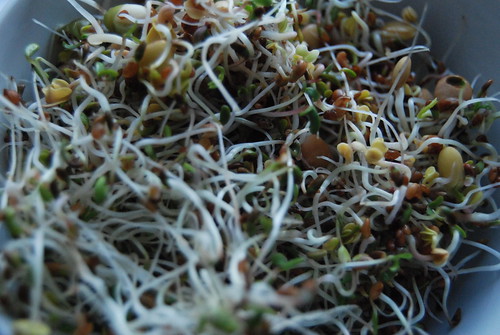
Perhaps the idea of growing sprouts seems absurd considering that they aren't particularly hearty, filling or gourmet. But sprouted seeds are a simple way to grow some of your own food, even in cold weather and they have a crisp, earthy taste that is great in salads, sandwiches or a stirfry.

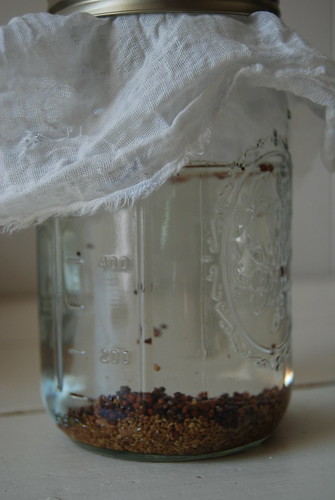
There are a variety of seeds that are good for sprouting. Radish, broccoli, alfalfa, and mung beans all make good sprouts. You can also get sprouting mixes and all of these can usually be found at natural foods stores. In addition to seeds you will need a quart sized jar with a piece of mesh (such as cheese cloth) that will cover the top and can be held securely in place with a jar lid or rubber band.

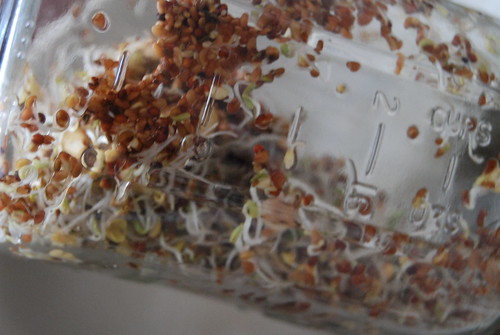
Add two or three tablespoons of seeds to the jar and fill with water. Cover the top of the jar securely with the screen. Rinse the seeds and then cover with water again. Let the seeds soak like this overnight. The next day, pour the water out of the jar (without removing the screen). Place the jar upside down in a bowl so the remaining water can drain.

sprouting

Rinse the seeds at least twice a day, or more if needed. The seeds (which will begin to sprout in a day or two) should not dry out, but they should not be too wet, either. I find that cooler months are best for sprouting because the seeds don't dry out too much and they stay fresher as they begin to grow.

seeds

Continue rinsing the seeds for a few days. Its best to keep the jar in the bowl someplace out of direct sunlight or high heat. I keep mine near the kitchen sink so I don't forget to rinse them and they get some indirect light so they are greener.

sprouting

The sprouts are ready when they are about half- to one-inch long. At this point I dump them out of the jar into a bowl of clean, cool water and give them another rinse. The seeds which didn't sprout will sink to the bottom, although its okay to eat those, too. Sprouts are best eaten when they are really fresh, and should be stored in a container that doesn't keep them too wet or compact them too much.

sprouts