February 29, 2012

Whole Wheat Sourdough Waffles

DSC_0123
DSC_0116

Sourdough is ideal for keeping a  chewy, hearty loaf of bread on hand, but crisp, light waffles also begin with sourdough. The starter imparts none of its sour flavor, but gives all of its leavening power to make the waffles light and fluffy and delightfully crisp on the outside. If I didn't like the bread so much, I would still be tempted to keep the starter around just to make these waffles. We don't eat them often, but they are one of my favorite breakfast treats.

As with anything involving wild yeast, it takes a few hours of planning ahead and a few minutes of work to have your perfect breakfast. Mix the starter, flour, and buttermilk the night before. The yeast works its magic, the flour soaks over night (which can reduce phytic acid and make it easier to digest) and in the morning you add eggs, butter, milk and baking soda. The batter rises rapidly and sizzles dramatically when it hits the griddle.

I like waffles plain, fresh off the griddle. I really like them with maple syrup. I love them covered with berries, and a scoop of yogurt or a dab of mascarpone butter. No matter how you like to eat these, you really can't go wrong.

DSC_0121
DSC_0133
DSC_0142
Whole Wheat Sourdough Waffles
Adapted from the King Arthur Flour Whole Grain Baking Book

2 tablespoons active sourdough starter
1 cup buttermilk (or 1 cup milk with a teaspoon of vinegar)
1 1/2 cups (6 ounces) whole wheat flour

Stir together the starter, buttermilk and flour until smooth. Cover and let sit for at least hours or overnight.

2 eggs
1/2 cup (4 ounces) milk
1/4 cup (2 ounces) melted butter
2 tablespoons sugar (optional and not really necessary)
1 teaspoon baking soda
1/2 teaspoon salt

When you are ready to make the waffles, beat the eggs and milk together until they are frothy. Stir the egg and milk with the melted butter into the starter mixture. Add the sugar (if using), baking soda, and salt and stir gently until the batter is smooth. Bake the waffles in your waffle iron as usual.
Makes 5-6 large waffles.

Mascarpone Butter
Creamy, with a hint of salt, this butter is perfect with acidic berries on top of waffles, pancakes or french toast. Simply mix 1 part butter and 2 parts mascarpone cheese in a food processor until it thickens to the consistency of whipped butter. Add salt to taste. Use liberally and keep refrigerated.


February 27, 2012

The Dexterity of Experience

DSC_0082


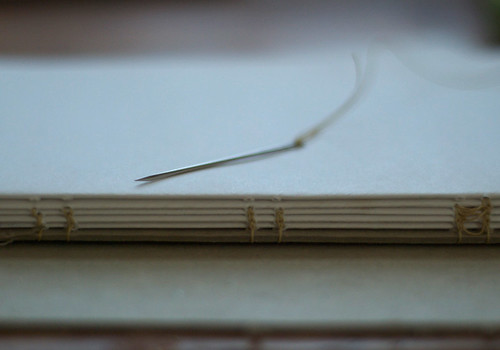
I needed a new notebook, so I sat down to sew one over the weekend. I've many of these coptic bound books since I learned the technique in college. I hadn't made a new one in a few years, but fortunately my fingers remembered just how to guide the needle. All of the small tricks I had picked up over time to make the process easier and create better results, came right back. It feels good to realize that I actually do know what I'm doing and I am developing creative skills.

I recently saw this clip from Ira Glass (thanks Kathie!) which really spoke to the challenge of creating and truly realizing your creative potential. It reminded me that practicing and working through the awkward stages of creating are crucial. Every sentence you write, every photo you take, every stitch you sew, every recipe you try, every mile you run, or whatever craft you are practicing, is part of your creative work. It might be messy at first, it might not be that good for a while, you might feel like you are not getting anywhere. Keep going.

Eventually, things will click, you will make something that turns out as you had hoped or better. And you will reach the point when your fingers can guide the needle with the dexterity of experience.

February 24, 2012

This Week

After four days away, I've been catching up on things in the studio. So here are some photos our trip the the north woods and boundary waters of Minnesota.

DSC_0029

DSC_0024


We skied on lakes in bright sun, dusk, clouds and snow. We saw eagles on an island and wolves at a preserve. We lounged and read by the wood stove and tried out the sauna.

DSC_0012

DSC_0028

If you ever have a chance to try dog sledding, you should. It was an amazing experience to learn about and travel with such hard working, happy dogs. Despite my worry about all the things that could go wrong and the fear that I was no match for six dogs that just wanted to run, driving the sled was amazingly fun.

DSC_0058

DSC_0068


I hope you're finding wondrous adventures, too!

February 23, 2012

Making Sourdough Bread

Once your starter is strong enough (a week to ten days after you started it), you can bake bread. Sourdough bread is leavened only by the wild yeast that has colonized your starter, though you can add a pinch of commercial yeast for extra lift, if you wish. This wild yeast needs a slow, cool rise as opposed to the warm quick rise of bread made with commercial yeast. I let my dough rise for most of the day and tend to it for a few minutes here and there. Longer rises build greater flavor in the bread but can be slowed even further by refrigerating the dough if you don't have time to get to the next step. You see, it takes some planning but doesn't require a lot of time or commitment to make incredibly delicious bread.

First: gather your ingredients. My favorite loaf right now uses a whole grain starter and a mix of whole grain flours and unbleached white bread flour. Keep it simple at first and try the same flour combination more than once until you are comfortable baking, then add other flours as you wish. It is easiest to use a variety of flours when measuring by weight rather than volume. Begin with: 

9 ounces of ripe starter
18 ounces of flour - for a lighter bread, use one third unbleached bread flour, then add whole wheat, (or whole spelt, rye, a little cornmeal...)
12 ounces cool unchlorinated water

Mix your dough: I like to knead and mix the dough by hand, but you can also use the dough hook of a stand mixer. The first mixing is just to combine the starter, flour and waters. Stir or mix them together until the flour and water are completely combined. The dough will be shaggy, not smooth. Cover and let rest for about 20 minutes. This rest is called the autolyse and it gives the flour a chance to absorb the water without salt interfering. The dough will be easier to work with after the rest. When you are ready, add: 

1 tablespoon honey
2 teaspoons salt

Knead the dough or mix it slowly in the stand mixer. It will be sticky and somewhat unwieldy. Wet hands don't stick as much to the dough. You can also flour your hands, but try not to add too much more flour to the dough. I like to knead my dough on a silpat to keep it from sticking to the counter. It is also helpful to use a bench scraper to scrape up the dough and knead it together. Work to incorporate the honey and salt and then continue kneading until it is smooth.

Coat the inside of a bowl with olive oil and place the dough inside it. Cover the bowl to keep the dough moist and leave it on the counter for 45 minutes to an hour. After the time has past, with wet or oiled hands, grab the middle of the dough. Lift it up so two ends of the dough hang down toward the bowl. It should be pretty loose and stretchy. Replace the dough in the bowl and lift it again, this time grabbing from the ends that were loose the first time. Cover the dough and let rest for another 45 minutes to an hour. Once the time has past, lift the dough the same way you did before. Cover and let rest for another 45 minutes.
DSC_0004

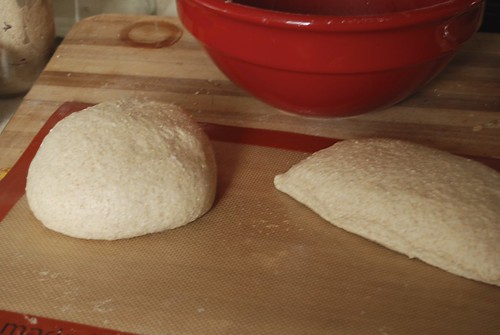
After the final rise in the bowl, it is time to shape the loaves. I like round, free form loaves, but you could also bake the sourdough in an oiled loaf pan. This recipe makes two small or one large loaf. Remove the dough from the bowl and place on a lightly floured counter or silpat. If you are making two loaves, cut the dough in half with a bench scraper or knife. To make round loaves, pull the edges of each piece of dough into the center. Use your hands to press the edges together and shape the dough into a round.

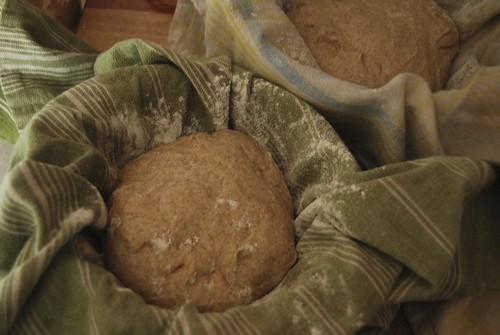
Sourdough bread does not hold its shape easily so it must be placed in a proofing basket or bowl to rise. Special banneton and other proofing baskets are available in stores, but all you really need is a clean tea towel and a bowl that will fit the round of dough. Sprinkle the tea towel with a generous amount of flour and use it to line the bowl. Place the shaped loaf, smooth side down, in the bowl. Cover and let rise.
DSC_0007

I usually let the dough rise longest when it is in the loaf shape because that makes the best loaf. Let it rise for a couple of hours. At least a half hour before you a ready to bake, preheat the oven to 450' F.  If you have a baking stone, make sure that is in the oven, too. If you do not have a baking stone, get a baking sheet ready for the loaves. At high heat my oven produces a nice crusty loaf so I don't bother to add steam to the oven. Added steam will ensure that your loaf has the crustiness of bakery bread. To create steam, place a cast iron pan on the bottom rack of the oven while it is preheating. Boil water on the stove before you put the bread in the oven. When you put the bread in the oven, carefully pour about half a cup of hot water into the cast iron pan (protect your hands from hot steam with oven mitts). Close the oven door and, after about five minutes of baking, check to see if there is still water in the pan. Add more if you need to.
DSC_0012

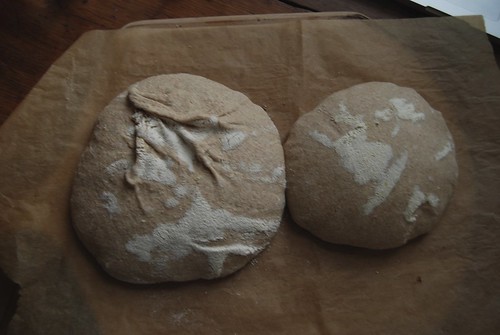
When the oven is ready and your shaped loaf has finished rising it is time to bake. If you are using a baking stone, it helps to have a peel, lined with parchment paper,  to slide the loaves onto the stone. Carefully lift the tea towel full of dough out of the bowl and gently flip the loaf over onto the parchment/peel or baking sheet, making sure not to deflate the risen dough. Brush off excess flour and slash the dough with a sharp knife or razor. The slash marks help excess steam escape in a decorative way. It can be tricky to get perfect slashes, but baking bread is best learned by doing.

Slide the bread into the oven, add steam if you like. After about 10 minutes, reduce the heat to 425'. Continue baking for 25 to 30 minutes more, until the internal temperature of the bread is 210'. The bread should make a hollow sound when thumped on the bottom if it is ready, but I always doubt myself when checking this way. Checking with an instant read thermometer will insure that your bread is cooked perfectly. When it is ready, remove the loaf or loaves from the oven and let cool on a rack.


Freshly baked bread is an amazing treat, I can never resist slicing off an end and spreading it with butter. Just be sure to let the bread cool for at least 20 minutes before slicing.

Questions? Tips? Techniques?  I'd love to hear from you.

February 22, 2012

Sourdough Continued: Feeding Your Starter

DSC_0046

If you've started your sourdough, how is it going? If your still uncertain and my endorsement isn't enough, here is some more inspiration. I wanted to share a few more ideas about keeping a starter and getting comfortable with itbefore I post my recipe for the actual bread.

Keeping sourdough going is often likened to having a pet on your kitchen counter. It is alive and requires regular attention, if you treat it right, it will love you back in the form of wonderful bread. On the other hand, when you don't have time to feed it or bake bread you can store it in the refrigerator and pretty much forget about it. If it feels like a little pet, it is not unheard of to give your starter a name. For some reason I've never felt that impulse.

Aside from using it for bread, it is good to get to know your starter. I have a laid back relationship with mine and feed it once a day. When I first started it, I carefully measured the flour and water but now I just eyeball the amounts to take out and put in and it is still thriving. Precision and giving your sourdough the best possible conditions can't hurt, but it is also important to make sourdough feeding and baking something that you can easily fit into your lifestyle, otherwise you'll never do it.

I usually bake one loaf each week and when I don't have a use for the extra starter, I refrigerate it until about 48 hours before I want to bake again. I have read that refrigerating will make the starter more sour. I haven't noticed a huge difference and for me it is easier to let it chill for part of the week rather than keeping it at room temperature and feeding it daily.

Keep an eye on your starter when it is on the counter. After you feed it, the starter will slowly rise and increase in size. When it reaches its peak, it will start to deflate slightly. It is best for using in bread dough before it has begun to deflate. As you are getting to know it, observe how long it takes for the starter to reach its full rise after feeding. That will be the optimal time to mix the bread dough.

After taking it out of the fridge, I feed my starter for a couple of days. I also make sure to feed the starter about 12 hours before I want to mix the bread. I use most of the starter for my bread dough but take what is left over and feed it again. With this small amount of starter, I can feed it several times (approximately doubling it each time) until I have enough to bake again. Thus, I don't have too much left over starter to throw out or find a use for.

A few resources that I have used for learning about sourdough: The Bread Baker's Apprentice by Peter Reinhart, The Bread Bible by Rose Levy Berenbaum, and The King Arthur Flour Whole Grain Baking Book (ideal if you want to make whole grain sourdough). Of course there are many other resources out there.

Tomorrow I will share my bread recipe and next week I'll have some ideas for what to do with the extra starter. Do you have sourdough going in your kitchen?

February 17, 2012

This Week In the Studio


I turned some of this fabric into these.


And these.


Six different designs are now available in six different colors. I am thrilled to be able to offer everyone a choice of color in their favorite design. I'll be making them to order.

Tomorrow we are headed to Ely, MN for a weekend of relaxing, cross country skiing, dog sledding, wolf visiting and more. Hope your weekend is adventurous, too!

February 15, 2012

Sourdough Starter (How To)

DSC_0045

Quite some time ago, I wrote about baking sourdough bread. I've been meaning to elaborate on that and give more specific instructions for making a starter and which will become the base for a tender crumbed, crusty loaf of bread. In my experiences baking sourdough bread, I've made loaves that were heavier than bricks and, with the help of a good teacher and a fancy oven, loaves that were as good as any bakery. The bread that I make about once a week during the colder months is perhaps not bakery ready, but not even close to brick-like. It is one of my kitchen staples which makes ideal morning toast, a very sturdy sandwich bread, and the one slice that I can never resist when it is still warm from the oven.

The starter, or levain, is what makes it sourdough. Sourdough bread does not always taste sour, but it should always be made from a starter of flour, water, and wild yeast that grows into a living source of leavening. Begin with a clean container to keep your starter in. I use a wide mouth, quart-sized mason jar which I swap out every so often for another clean quart jar. Mine is a whole-grain starter which I mix with white and whole grain flour when I make a loaf. Because whole grains are less refined and have more of their original parts, they usually have more wild yeast on them and are easier to use to start fermentation. Whole wheat, whole rye, or whole spelt can be used in the starter.

Add 4 ounces (1 cup) of whole grain flour to the jar or container where your starter will live (yes, it will soon be alive). You will also add 4 ounces (1/2 cup) of water, but make sure the water isn't full of chlorine, which could kill the yeast. Our water often smells like it, but chlorine evaporates easily, so I let the water sit out overnight before I add it to my starter. I find the simplest way to do this is to keep my tea kettle, which is always on a back burner of the stove, half full of water. Sometimes I forget to fill the kettle and I use water straight from the tap, but when you are first making a starter you should never use chlorinated water.

Stir the flour and water to form a paste. Cover the container loosely and keep it at room temperature for 24 hours. I keep my starter in an out of the way spot on the counter where I will see it and remember to feed it. Don't let it get too warm or too cold (I'll talk about refrigerating your starter later). I put a small plate or a canning lid (without the screw band) on top of the jar to keep it clean and covered. Do not tightly cover the jar or the gas produced by the yeast could eventually cause it explode.

At first not much will happen. After one day, discard half of the starter add another 4 ounces of flour and water, mixing together thoroughly. For the yeast to have enough food to thrive, the starter needs to double in size every day. To keep the starter from taking over your kitchen, home, backyard, in a matter of weeks it is easiest to remove half of the starter and double it from the remaining amount. Once your starter is strong and active you can use the discarded half to make pizza dough, waffles and many other baked goods.

DSC_0046

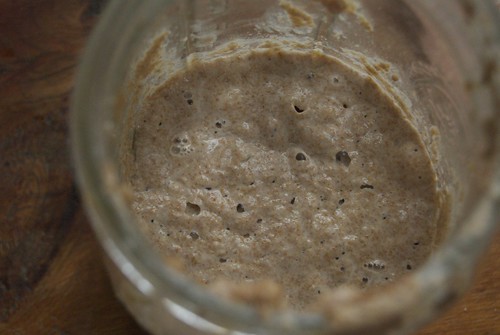
On day three, discard half of the starter and add another 4 ounces of flour and 4 ounces of water. You may start to see some bubbling and notice a yeasty aroma. For the next few days, you will feed the starter every twelve hours, discarding all but 4 ounces of the starter and then adding the same amounts of flour and water. After about 5 days, it should be very bubbly. I recommend continued feeding for a week or 10 days to make sure it is really strong and ready to make bread.

I hope this inspires you to get started. Please ask questions if you have them. I assure you that trying to make your own sourdough does not mean that you can escape feeding it day in and day out. There are many more resources out there and I have more to share, too. In a few days I will post about how I tend to my starter and then after that I'll post the basic sourdough bread recipe that I use. Tea recently wrote about sourdough and shared a lot of good information on starters and baking the bread on her lovely blog, Tea and Cookies.  

Sourdough bread from your own oven is delicious and healthy, a fun way to learn about fermentation, and a process that keeps you intimately connected to your food.

February 13, 2012

Moments to Pause

DSC_0041

As I poured water into my teapot this morning, and watched it filter through the tea leaves, I thought about how few rituals I have. When I was in Tanzania, stopping for tea was a social necessity which began nearly every meeting and provided a mid-morning break that stopped everyone in their tracks. I don't know of any equivalent in this country, but since I spend almost all week and weekend working from home by myself or serving other people meals I might be missing it.

Lately, I have been feeling the need for a bit more quiet and have been trying to find moments to pause. While cutting, ironing, or sewing fabric, I often listen to my favorite podcasts. I enjoy reading other blogs and keeping up with the news by listening to NPR while I cook or do the dishes. Most of what I choose to listen to or read is compelling, informative, often beautiful and very enjoyable but there is just so much of it.

Of course I can turn it off and let it go anytime. I've been trying to take some time every day or week to relax and focus on reading a book or knitting or doing nothing without anything else in the back- or foreground. Sadly this winter has not brought us any snowstorms which are one of my favorite ways to let go of everything else and simply enjoy the day. I am trying to make more time for setting aside distractions and focusing on the small things. I am always working on projects that I love, but it is nice to have something that I am doing just for myself when I can let go of everything else for a few minutes or hours.

What do you do to let go?

February 10, 2012

February 8, 2012

Brussels Sprout Hash

DSC_0075

When I think about cooking, I often dwell on the transformation that occurs by combining ingredients, heat, stirring, blending or chopping. I suppose transformation is at the heart of most cooking. Sometimes it is dramatic, like making mayonnaise, caramelizing onions, turning juice and zest into curd. Other times it is simple and there is nothing stunning about it. I recently discovered that humble, often maligned, brussels sprouts can be transformed from orbs of tightly bound leaves into a simple hash that brings out their flavor and glorious green-ness.

As I mentioned on Monday, there's not much nothing growing around here this time of year. The brussels sprouts that I bought at the co-op are California natives, but after enjoying a brussels sprout hash as part of a restaurant meal, I couldn't resist trying it in my kitchen. There are certain foods and flavors that just taste nourishing. Not in a oh this must be healthy because it tastes awful sort of way but in a way that makes me physically feel good, and nourished as I eat it. When fresh vegetables are less abundant it is easy to not eat enough of them and to gravitate toward foods that I crave regardless of whether they are good for me. Then I rediscover those nourishing tastes and now lovely these little sprouts can be.


Brussels Sprout Hash
I always want to call this recipe a slaw but because it is cooked, it must be a hash. I recently purchased a fairly cheap and slightly dangerous mandolin and used that for shredding the sprouts. A knife will work fine, just slice them as thinly as you can. This recipe is loosely based on one from Epicurious.

1 pound of brussels sprouts
2 small shallots
3 tablespoons butter
balsamic vinegar
salt and pepper

Rinse the brussels sprouts, remove any obvious yellow leaves or bad spots. Slice them very thinly so that the leaves become very thin short ribbons.

Thinly slice the shallots. Place a skillet or saute pan over medium-low heat and add a tablespoon of butter. When the butter has melted, add the slices shallots and let them cook, stirring occasionally until they are caramelized. If they stick to the pan or start to burn, like mine did, add a splash of balsamic vinegar and scrape everything off the bottom of the pan. When the shallots are caramelized, remove them from the pan.

Turn the heat to medium-high and add the remaining butter and the shredded brussels sprouts. Stir the sprouts so they cook evenly. They should brown and caramelize slightly over the heat but not become overcooked and soggy. When they are becoming a bright, cooked, green (3-4 minutes) add the cooked shallots, another splash of balsamic vinegar and salt and pepper. Stir to combine, taste to adjust seasoning and serve immediately.

February 6, 2012

Blood Orange Curd

bloodorange

Midwinter brings an abundance of citrus, even in this northern climate where nothing is growing outside. It has been very gray and lukewarm (well, really luke-cold, but much warmer than winter should be) here and the brightness of oranges, lemons, grapefruits and clementines are most welcome. It was just about this time last year that I wrote about lemon curd. Apparently early February makes me want citrus and sweetness.  Citrus curd combines the sharp acidity and unmistakeable flavor of a lemon or orange with the darlings of baking: sugar, butter and eggs. When whisked together the complicated, pithy orange becomes as luxurious as a cashmere scarf, a versatile and welcome accessory to many desserts.

meringues

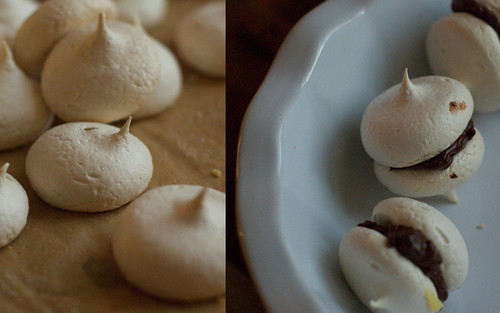
Lemon curd is classic, but orange, or blood orange curd reminds us to pause and really taste. The flavor of the curd is more subtle and the vibrant red juice of the orange gives it a blush of pink. I filled almond cookies and tiny meringues with blood orange curd, lemon curd or chocolate ganache turning them into decadent, if rustic, sandwich cookies. The almond cookies were perhaps too buttery and rich along with the curd, but our dinner guests had no complaints. The meringues emerged from the oven so crisp that they shattered when I took a bite. After snuggling next to a layer of curd they relaxed into soft pillows with a delicate crust. This curd can be used in many different ways, I have also been dreaming of spreading it between layers of chocolate cake.

Blood Orange Curd
This recipe is very similar to the Lemon Curd recipe, but since oranges are much sweeter, I decreased the amount of sugar. Because of this, the curd is a little softer than the lemon curd and might benefit from an extra minute or two of stirring, but either way it is sturdy enough to spread or sandwich.

3 large eggs
4 ounces sugar
3 ounces (6 tablespoons) plus one teaspoon blood orange juice
Grated zest of 3 blood oranges
6 1/3 ounces (1 stick plus 4 1/4 tablespoons) unsalted butter, at room temperature

To start, you will need a heatproof bowl and a saucepan large enough to hold the bowl. Fill the saucepan with water so that the bowl can rest on the pan without touching the water. Bring the water to a simmer. Place the eggs, sugar, blood orange juice and zest in the heatproof bowl and whisk to combine. Add the butter and place the bowl on the saucepan, over the simmering water. Whisk to melt the butter and continue whisking to ensure even cooking. The heat should be evenly distributed on the bottom of the bowl so that nothing will burn and the eggs won't cook too quickly. Continue whisking for about seven minutes until the mixture becomes quite thick and light.

Remove from the heat and pour the curd through a fine mesh sieve into a clean bowl to remove the pieces of zest and any egg that may have cooked. Store in an airtight container in the refrigerator.


February 3, 2012

This Week in the Studio


It has been a busy week here. I finished some napkin sets and added them to the shop. I also placed my first wholesale fabric order this week and I am excited about the possibilities that this will allow me to try and the new things I will be able to make and offer in my shop.

I got to see and listen to Gabrielle Hamilton read from her book, Blood Bones and Butter. She advised that you should be careful what you get good at because you might be doing it forever. She also described the experience of coming to a fork in the road of life and thinking that she had chosen one direction and let go of the other forever, but then found that down the road the two paths came together again.

We are having several friends over for dinner on Saturday so I am trying some new recipes and ideas. I'll be back next week to share some of them with you. Hope you had a good week and enjoy whatever you weekend may bring!